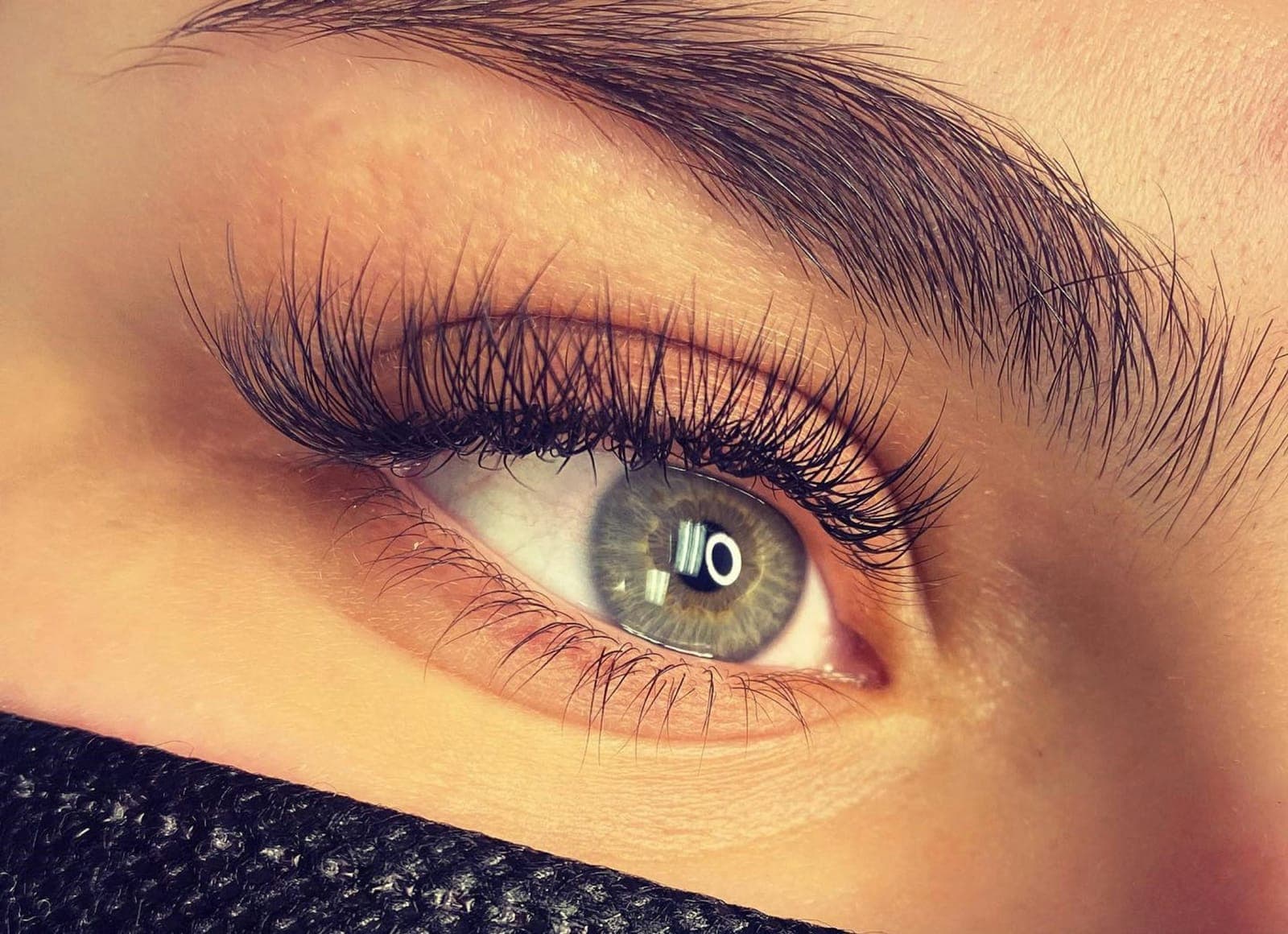
I learned Russian volume at the source, in the lineage of the Russian school that invented the technique. And if there is one thing I repeat to every group I train, it is that Russian volume cannot be improvised: it is learned, one gesture at a time, one fan at a time.
Many beauticians want to add it to their menu because it is the most in-demand and best-paid service in the trade. They are right. But before it becomes a source of income, it has to become a genuine skill. Here is what Russian volume really is, what you learn when you train in it, and why supervised, hands-on practice on real models changes everything.
What exactly is Russian volume?
Russian volume, also called "volume" or the "Russian school", means building fans by hand ("bouquets" of 2 to 8 ultra-fine extensions) that you place onto a single natural lash. Where lash-by-lash, the classic technique, bonds one extension to one lash (the well-known 1:1 ratio), Russian volume multiplies the tips to create density, a soft gradient and a full, fluffy look.
What truly defines the Russian school is not only the result: it is the gesture. The fan is built lash by lash, pinched, closed at the base, then placed with millimetre precision. The extensions used are ultra-fine (0.03 to 0.07 mm) precisely so that a full bouquet stays lighter than a single thick classic extension. That paradox is the beauty of the technique: more lashes, less weight.
Why it is the most sought-after skill
In my studio, as with most colleagues I know, Russian volume is the service that fills the calendar most. Clients ask for it by name. And because it demands more technique and more application time than lash-by-lash, it commands a noticeably higher price.
For a technician, knowing how to do Russian volume is therefore not a decorative option on the menu: it is the line that makes the difference to your revenue. A professional who only offers classic quickly hits a ceiling; the one who masters volume (and then mega-volume) retains clients better and charges more. It is one of the points I develop in my guide on how to choose a lash extension training.
What you actually learn in Russian volume training
Training in Russian volume is not about watching a video and buying some lashes. It means acquiring, in order, a series of precise gestures:
- Making the fan by hand — the heart of the technique. Picking up 2, 3, 4 tips or more, opening them evenly, closing the base cleanly. This is what takes the most repetition.
- Managing weight — learning to calculate what a natural lash can carry. A fan that is too heavy (too many tips, the wrong diameter) damages the lash. You learn to balance diameter, length and number of tips.
- Isolation — separating a single natural lash from the rest to place the fan on it, without "stickies" (several lashes bonded together, the mistake that breaks natural lashes).
- Lash mapping — drawing the layout before you start, adapting lengths and curls to the shape of the eye for a harmonious look.
- Speed — it comes last, never before consistency. A perfect but slow fan can be fixed with practice; a fast, sloppy fan has to be relearned from scratch.
Lash-by-lash or Russian volume: which skills to learn?
The two techniques are usually compared from the client's point of view. From a training standpoint, they are really two distinct skill sets, learned one after the other.
| Skill to acquire | Lash-by-lash (classic) | Russian volume |
|---|---|---|
| Core gesture | Isolate and place 1 extension on 1 lash | Build a fan of 2 to 8 lashes by hand |
| Diameter worked | 0.15 to 0.20 mm | 0.03 to 0.07 mm (ultra-fine) |
| Key concept | Isolation and adhesion | Pinching, symmetry and a closed base |
| Weight management | One lash, one weight | Total fan weight on the natural lash |
| Learning curve | Accessible from the start | Gradual, needs repetition |
| Outcome and pricing | Entry-level service | Premium service, better paid |
This is why, in my training, we never skip the lash-by-lash stage: it is the foundation Russian volume is built upon.
Why supervised practice on real models is essential
You do not become a Russian volume technician on a plastic mannequin. The mannequin helps you understand the gesture; a real lash moves, sticks, reacts to humidity and comes in a thousand different densities. The technique settles in only when you work on real models, with a trainer correcting your hand in real time.
That is why I always favour in-person training. A 100% online course can pass on the theory; it cannot catch a badly closed fan at the right moment, or adjust your posture or your pinch while you apply. Real-time correction saves months of practising blind.
In Russian volume, it is not speed that makes the technician, it is the consistency of the fan: a symmetrical bouquet, closed at the base and open at the tip, made a hundred times over until the hand does it on its own.
Our in-person Russian volume training in Toulouse
At Beauty'n'Form, at 109 avenue des États-Unis, 31200 Toulouse, I built my training in the lineage of the Russian school where I learned myself. Over three in-person days, in a small group, we start with lash-by-lash to lay solid foundations, then move into Russian volume: fan making, weight management, isolation, mapping, and a full application on a model.
The programme, the day-by-day schedule and the prerequisites are detailed on the page for our lash-by-lash and Russian volume training in Toulouse. It is a Qualiopi-certified training. You will find my full catalogue on the training page.
Who is this training for?
It is aimed at two profiles. First, career changers starting from zero: no beauty diploma is required to apply lash extensions in France, but serious training is essential since you work a few millimetres from the eye. Second, working beauticians who want to move upmarket, add volume to their menu and raise their average ticket.
In both cases the goal is the same: to leave with a reliable, repeatable gesture and enough to start practising straight away. And for those who want to understand the look from the client's side first, I explain the differences in Russian volume vs classic. If you would rather discover the technique as a client before training, you can also book an appointment at my studio.
Frequently asked questions
Ideally, yes. Lash-by-lash teaches isolation, precise placement and how to read natural lashes: these are the foundations of Russian volume. In my training we do not separate them; we start with classic and build volume on top. A complete beginner can therefore learn everything in a single course, provided that order is respected.
The in-person training lasts three days and is enough to leave with a sound gesture and a first full application on a model. Mastery itself comes with repetition: expect several weeks of regular practice to build fast, consistent fans. Speed always follows consistency, never the other way around.
Beauty'n'Form is a Qualiopi-certified centre. Depending on your situation, several funding options (France Travail, OPCO, FAFCEA, your company's skills-development plan) or payment in instalments may cover part or all of the cost. I guide you through the paperwork from your very first contact.
Yes. No beauty diploma is required to apply lash extensions in France, and no prior experience is needed to start. What matters is serious professional training, plenty of supervised practice on real models, and professional liability insurance before you take on your first clients.
Mega-volume is an extension of Russian volume: you build even fuller fans (often beyond 8 tips) with even finer lashes. It is tackled once Russian volume is well established.

Training a technician in Russian volume means passing on a gesture that will stay with her for her whole career. I take the time to correct every hand until the fan is consistent, because that detail is what separates a pretty set from professional work. If the trade appeals to you, write to me: I will tell you honestly where you stand and where to start.