
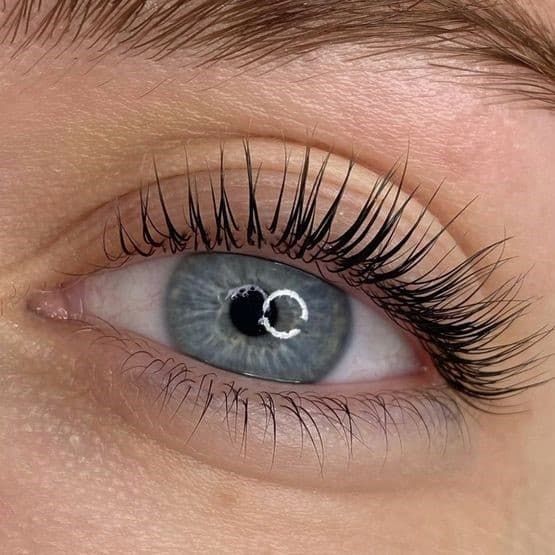
For a few months now, one question has come up in the studio more often than any other: "what exactly is the Korean lash lift?" It almost always follows a scroll through social media, where the technique circulates a great deal and is explained rather badly.
So let me answer it plainly, with what I see on my own clients. The difference comes down to one thing: there is no glue. Everything else follows from that, and that "everything else" matters more than you would think.
First, what a lash lift actually does
A lash lift adds nothing. It works your own lashes, curling them from the root to open up the eye. No extensions, no strip lashes, no obligatory mascara: your lashes, better placed.
The principle is the same in both methods. A silicone shield is laid against the eyelid, the lashes are set on it, then two lotions follow one another: the first opens the lash fibre so it takes the shape of the shield, the second closes it again to lock the curl. The result holds for six to eight weeks, the time your lashes take to renew.
What the Korean method changes is the step in the middle: how the lashes hold on the shield.
The real difference: glue, or the absence of it
In a classic lift, each lash is fixed to the shield with an adhesive. That is what allows them to be placed one by one, properly aligned, without moving while the lotions do their work. It is effective, and it is the technique I was trained on.
The Korean method does without that adhesive entirely. The lashes hold another way, and the protocol is built around that absence.
Three concrete consequences, and these are the ones a client cares about:
- Less product laid near the eye. A classic lift lays down glue, two lotions and a care product. The Korean version removes one layer from that list.
- A faster appointment. Without the lash-by-lash gluing step, the session shortens noticeably. Allow one hour to an hour and a half, against a good hour and a half for a classic lift.
- A simpler removal. Less product laid on means less product to take off at the end.
Let me be clear, because the question always comes: the glue used in a classic lift is not dangerous when it is applied properly, by someone trained, on a healthy eye. It is not a technique to avoid, and I still perform it every day. It is simply that if the same result can be had with one product fewer, that deserves to be offered.
Korean or classic: the table
| Classic lash lift | Korean lash lift | |
|---|---|---|
| Lash fixation | Adhesive on the shield | No glue |
| Appointment length | About 1 h 30 | 1 h to 1 h 30 |
| Products laid on | Glue, lotions, care | Lotions, care |
| How long it holds | 6 to 8 weeks | 6 to 8 weeks |
| Effect obtained | Clean, defined curl | Clean, defined curl |
Notice the last two rows: hold and effect are the same. I put it even more plainly to my clients: once the appointment is over, with the naked eye, you cannot tell which method was used. The difference is in the protocol, not in the mirror. That matters, because you often read that the Korean method gives a "more natural" result. It is not the technique that decides this, it is the shield size and the mapping, that is to say how the curls are distributed across the eyelid. Both methods can be discreet, and both can be dramatic.
Who I recommend the Korean version to
It is not "better", it suits particular situations.
Sensitive eyes. If your eyes react easily, water, or if you have felt discomfort during a previous appointment, taking one product out of the equation is genuinely more comfortable.
Tight schedules. A shorter appointment is one that fits into a lunch break. It sounds trivial, and yet it is the number one reason my clients give.
Fine lashes. Less handling on fragile lashes is always worth having. That said, it does not replace real care: if your lashes are damaged, we talk about it first, and sometimes I would rather postpone.
On the other hand, if you want very precise lash-by-lash placement on a difficult eyelid, the classic fixation sometimes gives more control. That is a judgement I make at the consultation, not a rule.
The golden rule: do not choose the technique. Describe the result you want and let your technician choose. A good practitioner masters both and will tell you which one serves your eyes, on that day, with your lashes.
How to care for a Korean lash lift
Exactly like a classic lift, and that is logical: once the appointment is over, your lashes are in the same state.
The first 24 hours are the only ones that really count. The curl stabilises during that time. So no water, no steam, no sauna or hammam, no eye makeup, and avoid sleeping with your face crushed into the pillow.
After that, the routine is light:
- Brush your lashes every morning with a clean spoolie, that alone keeps them aligned.
- Nourish them with a serum or castor oil in the evening, from the second day. A supple lash holds its curl better.
- Skip the eyelash curler, now pointless, and which breaks a curl already made.
- Mascara is fine, from the second day, ideally not waterproof so you never have to rub it off.
You will find the products and the gestures in detail in my lash extension aftercare guide, whose cleaning section applies to a lift as well.
What about tinting?
It is the option that most often goes with it, in both methods. The lashes are coloured right after the curl, which adds about ten minutes to the appointment and replaces mascara day to day. On light or blond-tipped lashes the difference is striking, far more than the curl alone.
Lash botox is something else: it is a care product that coats and hydrates the fibre. It curls nothing, it helps a tired lash cope better with the curl. We add it when the consultation calls for it.
How long before doing it again?
Six to eight weeks, and you have to resist the urge to come back sooner. Your lashes grow: after three weeks the new ones arrive straight at the root while the older ones keep their curl. That is normal, it barely shows, and running two lifts too close together tires the fibre.
If your curl drops after two weeks, the method is not to blame: it is either an oily product used without realising it, or a processing time badly matched to your lashes. Mention it to your technician, she will correct it at the next appointment.
FAQ
No more than a classic lift, and slightly less product is laid on since there is no glue. What damages a lash is not the method, it is a processing time badly matched to its nature, or appointments too close together. Six to eight weeks between two lifts is the real safety rule.
One hour to an hour and a half, against a good hour and a half for a classic lift. The time saved comes from the gluing step, which disappears. Add about ten minutes if you have a tint.
No, and that is the most widespread misconception. The result, discreet or pronounced, depends on the shield chosen and the mapping, not on whether glue was used. Both methods can do either: say the result you want, your technician will pick the technique.
No. A lift works the natural lash, and it is never performed over extensions in place. If you wear them, you need a professional removal first, then let your lashes rest before considering a curl.
Not during the first twenty-four hours, while the curl settles. After that yes, mascara included, ideally not waterproof so you never have to rub it off.
Where to get a Korean lash lift in Toulouse
I perform both methods at the studio, in north Toulouse, and the choice is made at the consultation, with you. You can see the prices and book on my lash lift page.
And if you are a professional, or retraining, know that the Korean method is learned in a single day, alongside the classic lift. For a technician the benefit is twofold: the application is faster, so you fit more appointments into a day, and it uses less product, so your margin is better at the same selling price. That is the content of my lash lift training, a single seven-hour day, in a very small group, with practice on a live model.
If you are still hesitating between a lift and extensions, my article on lash lift versus lash extensions compares the two on hold, upkeep and budget.